
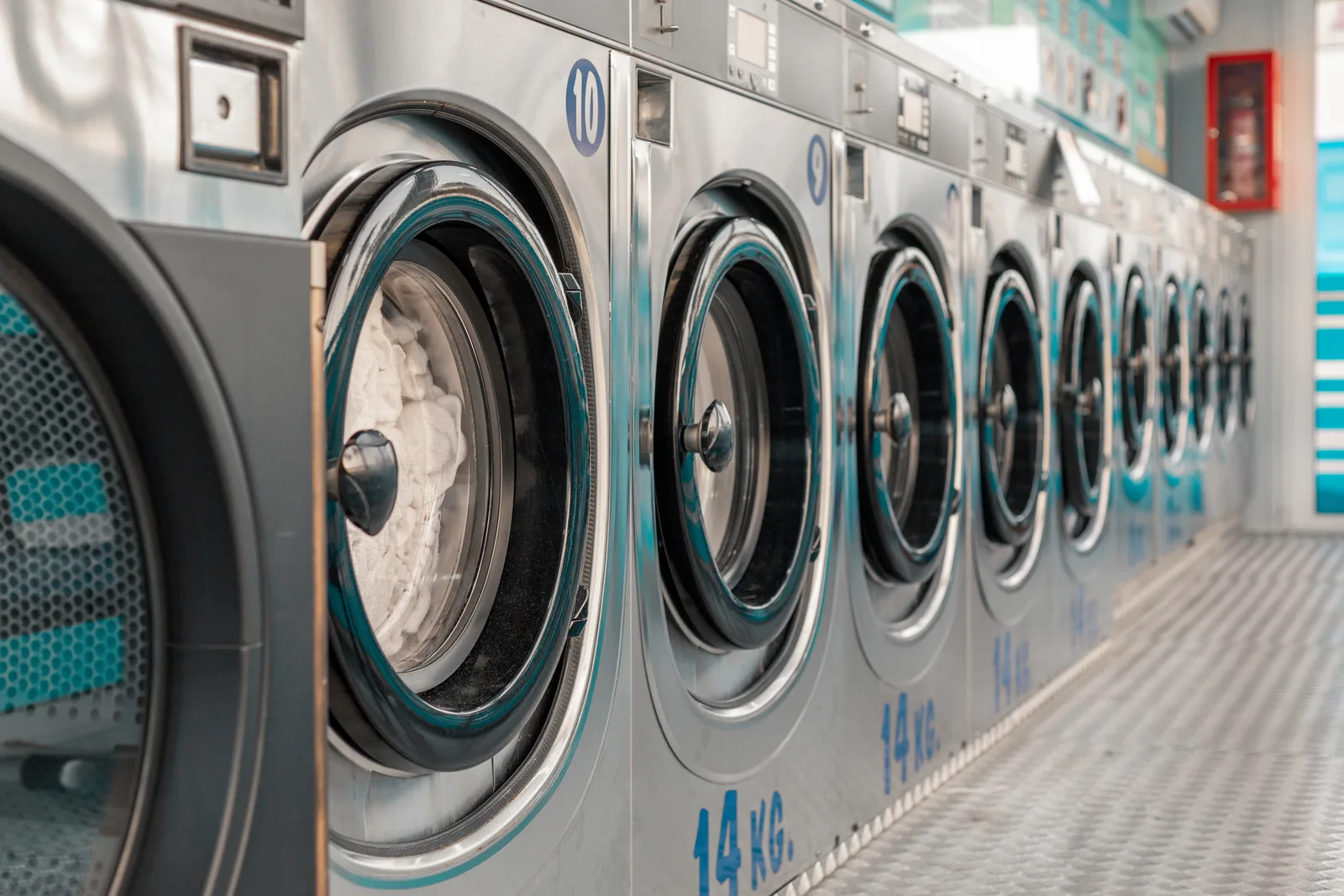

Equipment breakdown premium for a laundromat tracks the mechanical and pressure-vessel exposure in the store: how many machines you run, how old they are, whether dryers burn gas or run on electricity, and the capacity of any boiler or commercial water heater. Each factor raises or lowers the failure the carrier expects to pay.
What equipment breakdown coverage prices
Equipment breakdown covers sudden, accidental mechanical or electrical failure of the systems a laundromat depends on — washer and dryer motors, control boards, water heaters, boilers, and electrical service — which standard property insurance excludes. Because the line protects the working guts of the store, its premium is driven by the size, age, and type of that mechanical lineup rather than by square footage alone. The more failure-prone value sits under the roof, the more the carrier expects to pay. We cover the line’s mechanics in the equipment-breakdown coverage primer and the policy line itself at equipment breakdown coverage.
Machine count: more units, more failure points
Machine count is a primary driver because every washer and dryer is an independent point of failure holding replaceable value. A larger fleet raises both the modeled frequency of a breakdown — more motors, more control boards, more bearings to fail — and the severity of a worst-case event. This is the same concentration logic that lifts property insurance on a high-density store, so the two lines tend to move together. The drivers here also overlap with the broader cost-driver overview, where machine mix appears as one factor among several.
Equipment age and the replacement schedule
Aging equipment costs more to cover because old motors, bearings, and control boards fail more often, and obsolete parts lengthen downtime. A fleet of newer, well-serviced machines models as lower breakdown frequency than an aging lineup running past its design life. The lever an owner controls is documentation: service records, a replacement schedule, and proof that failing units get retired rather than nursed along. That evidence gives the underwriter a verifiable reason to price the age of the fleet more favorably at renewal.
Dryer fuel source: gas versus electric
Fuel source is a distinct rating input because gas dryers add combustion to the failure picture. A gas-fired unit carries ignition, gas-supply, and venting components an electric dryer simply doesn’t have, which raises both breakdown and fire-loss modeling. Gas dryers also tie directly into lint-fire risk, the subject of the dryer-lint fire-prevention checklist. The relevant fire-safety expectations live in the NFPA codes and standards, and national fire-incident context is published by the U.S. Fire Administration. A store that maintains gas units rigorously — or converts to electric — can shift how this exposure prices.
Boilers and commercial water heaters: pressure-vessel exposure
A boiler or large commercial water heater is the highest-attention item on the list because pressure vessels carry both breakdown and explosion exposure. Capacity drives the price: a higher-output unit concentrates more energy and more potential damage in a single vessel. Carriers commonly require inspection records for pressure equipment, and documented compliance with applicable mechanical and pressure-vessel codes supports favorable pricing. Workplace-safety expectations around this equipment fall under OSHA 29 CFR 1910. A single boiler failure can idle much of a store at once, which is why this exposure carries weight beyond its unit count.
Real-World Scenario: An owner runs a busy store anchored by a single gas-fired boiler that feeds hot water to every washer. The boiler is past its inspection interval and the owner has no service records on file. When the underwriter reviews the renewal, the missing inspection history forces a cautious view of the most consequential single point of failure in the building — the one unit whose breakdown could take the whole store offline. The owner schedules a pressure-vessel inspection, repairs a flagged relief valve, and files the certificate with the agent. At the next renewal, the documented inspection and the corrected valve give the carrier concrete evidence that the store’s largest exposure is being managed, and the equipment-breakdown component is priced on facts rather than on the worst assumption.
Electrical service and the systems behind the machines
The building’s electrical service is an often-overlooked driver because every motor and control board depends on it. Aging panels, undersized service, or a history of nuisance trips raise the modeled likelihood of an electrical failure that can damage multiple machines at once. A documented panel upgrade or a clean electrical inspection supports more favorable pricing, and it interacts with the building-age factor that shapes the operating-model cost picture. Coin and vend metering on the machines is itself a commercial measuring device subject to the standards in NIST Handbook 44, so the control electronics carry both a breakdown and a measurement-accuracy dimension. Underwriters treat the electrical backbone as the shared system whose failure can cascade across the floor.
Why a single failure can cost more than its part
Equipment breakdown severity isn’t just the price of the failed component — it’s the chain of consequences a failure sets off, and that chain is what carriers model. A failed control board on one washer is a small event. A boiler failure that shuts off hot water to every machine, or a main electrical fault that damages multiple units at once, idles the store and triggers a much larger loss. The drivers that concentrate this risk are the shared systems: the boiler, the electrical service, and any common water-heating plant. That’s why a store with many machines fed by a single boiler can carry more equipment-breakdown weight than a store with the same machine count and several independent water heaters — the second store has no single point whose failure takes everything down. Owners evaluating a purchase should map these shared systems early, a step covered in the buying-a-laundromat checklist. The takeaway is that redundancy and the distribution of critical systems matter to the premium as much as raw machine count does.
How equipment breakdown pairs with business income
A breakdown that idles machines doesn’t only cost repair money — it stops revenue, which is why many programs tie business-income protection to a covered breakdown. When a single failure can take much of the store offline, the lost-income exposure becomes a real part of the breakdown picture rather than an afterthought. The relevant drivers are the same ones that concentrate severity: shared systems whose failure idles the whole floor, and the time it takes to source parts for older or obsolete equipment. A store running newer machines with readily available parts recovers faster, which limits the income loss; an aging fleet with hard-to-find components stays down longer. Documenting parts availability and a service relationship that promises fast turnaround supports both the breakdown and the business-income side of the program.
Maintenance: the lever owners actually control
Preventive maintenance is the most direct way to influence the premium because it reduces the failure frequency the carrier expects to pay. A documented program — motor service, descaling, boiler inspections, electrical checks, and a clear retirement schedule for aging units — gives the underwriter verifiable evidence of lower expected loss. Maintenance logs and inspection certificates are exactly the kind of proof that moves pricing, and they pair naturally with the housekeeping discipline behind reducing slip-and-fall risk. The goal is to convert “trust me” into documentation.
Pulling the breakdown picture together
Equipment breakdown rewards a store that can show modern, well-maintained equipment and a managed approach to its highest-energy systems. Count, age, fuel source, and boiler capacity set the baseline; documentation moves the price within it. The most efficient structure usually layers equipment breakdown alongside property, general liability, and, where staffed, workers compensation under one program. Present an accurate equipment list — counts, ages, fuel sources, and boiler capacity — on a single quote submission, and review how the panel approach works on the about page.