
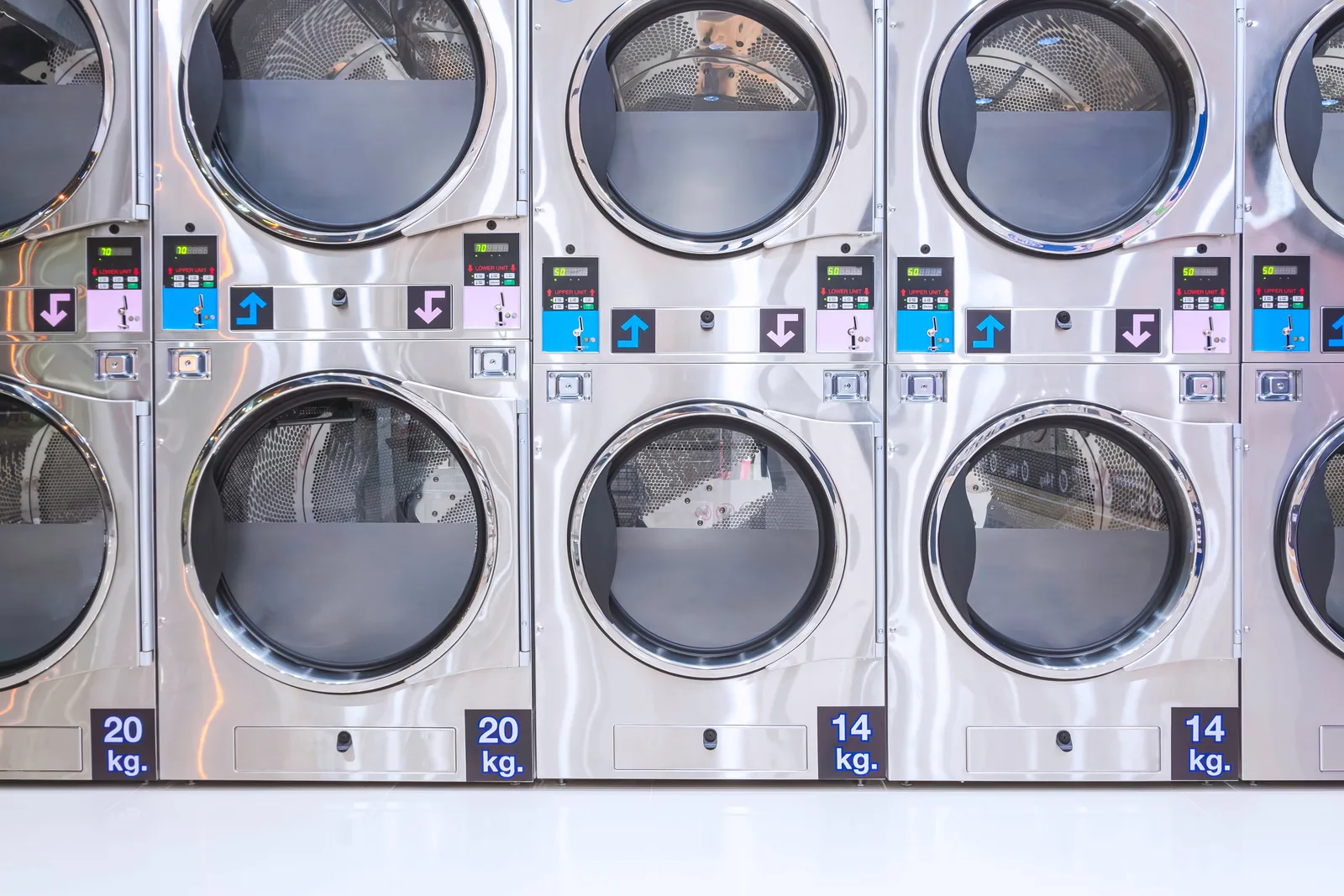

A laundry business is insured around the textiles it handles for other people, the contracts it signs to do so, and the staff who run the equipment. The liability and property foundation resembles a coin laundromat, but bailee’s coverage, workers’ compensation, and contract-driven liability carry far more weight, and auto joins the program when vans make deliveries.
What separates a laundry business from a coin laundromat
A coin laundromat rents machine time to walk-in customers who do their own work. A laundry service, a wash-and-fold shop, or a commercial laundry takes in someone else’s textiles, processes them, and returns them finished. That difference moves nearly every risk in the building. The goods are in your custody, your employees touch them, and your promise is a clean, intact result delivered on schedule.
Our guide on adding wash-dry-fold to a self-service site covers the transition for a coin operator. This post looks at the broader family of service-based laundry businesses, from a neighborhood drop-off counter to a plant that serves restaurants, salons, and care facilities. The full-service laundromat page describes the attended model most owners start from.
Goods in your custody are the central exposure
Every item a customer hands over becomes your responsibility until it is returned. General liability does not respond to that responsibility in the usual way, because it generally excludes property in the insured’s care, custody, or control. Bailee’s coverage fills the gap, paying for loss, theft, fire damage, or mishandling of goods held for others. The bailee’s coverage page and our deeper explainer on customers’ goods describe the structure.
The right limit depends on what sits in the building at the busiest moment, not on the average day. A plant that stages bulk linens ahead of a delivery run holds more value on a Thursday evening than on a Monday morning. Ask how the policy values textiles, whether it pays replacement or depreciated value, and how it treats items that arrive already worn. Those answers decide how a claim feels to the customer, and they are worth settling in writing before any loss occurs, because a dispute over valuation is far harder to resolve after the goods are already gone.
Contracts shape the program
Business customers bring paperwork. A restaurant group, a salon chain, or a care facility may require proof of coverage, ask to be named as an additional insured, and shift responsibility for lost or damaged linens onto the laundry. Some agreements also include indemnity clauses that make you answerable for more than the law would otherwise require.
Treat every service agreement as an insurance document. Before you sign, send it to your agent and ask whether the existing policy satisfies it. A requirement the program cannot meet is far easier to fix before the account starts than after a loss has exposed it. Our post on landlord, lender, and city requirements lists the terms worth recognizing, and many of them show up in customer contracts as well.
Real-World Scenario: A wash-and-fold shop wins a contract with a neighborhood restaurant group. The agreement requires the shop to replace any lost linens at full cost and to carry coverage that names the restaurant group on the policy. The owner signs without reading the insurance clause. After a delivery mix-up, the group demands payment, and the owner discovers the policy neither names the customer nor covers the shortfall.
Employees and the injury profile
Laundry production is physical work. Staff lift wet bulk loads, work around heat from dryers and presses, and repeat the same folding and sorting motions for hours. Burns, back strains, slips, and repetitive-motion injuries are the predictable results, and workers’ compensation is the line that answers them.
The premium is built on payroll and job classification, so accurate reporting of who does what matters. Part-time and seasonal help count, and misclassifying production staff as clerical staff invites an audit adjustment. Federal workplace-safety rules under OSHA general industry standards shape machine guarding, hazard communication, and walking surfaces, and following them reduces the injuries that drive claims. Our post on attendants and part-time laundromat staff covers the staffing questions in detail.
Equipment, utilities, and production downtime
A laundry service lives or dies on throughput. When a boiler, a tunnel washer, an extractor, or a bank of dryers stops, orders back up and customers look elsewhere. Equipment breakdown insurance pays to repair or replace machinery after sudden mechanical or electrical failure, and business income coverage replaces revenue lost while production is down.
Utilities deserve a separate question. A plant that depends on steam, gas, or heavy water service can be shut down by an outage that starts off premises, and not every policy treats that as a covered cause. Ask whether utility service interruption is included, and whether the form distinguishes between direct damage to your equipment and a failure upstream of the building. Plants that rely on a boiler for steam should also ask about jurisdictional inspections, since many insurers require current inspection certificates before they will cover pressure vessels. The consensus fire standards published by the National Fire Protection Association also bear on how heat-intensive equipment is installed, vented, and maintained, which underwriters watch closely.
Fire, water, and chemical exposure in the plant
A laundry plant combines heat, lint, water, and chemicals inside the same building, and each of them shows up in the property program. Lint is the classic fire source: it collects in dryer ducts and around heating elements, and a written cleaning routine with service records is the strongest evidence an underwriter can see. The Consumer Product Safety Commission publishes dryer fire and equipment recall information that is worth checking against the machines you own.
Water is the quieter threat. Supply lines, drains, and water heaters sit behind or beneath production equipment, and a failure can flood a floor overnight. Chemical storage adds a hazard of its own: detergents, bleaches, and solvents need labeled storage, safety data sheets, and trained staff. Insurers do not ask for perfection, but they do ask whether these controls exist and whether anyone checks them.
Claims handling and the customer relationship
How you handle an early complaint often decides whether a claim happens. A customer who reports a stained garment wants a response, not a coverage lecture. Keep intake records that show the condition of items when they arrive, photograph unusual items, and post clear terms about liability limits for delicate or high-value goods. Those habits do not replace insurance, but they give the policy something to work with.
When a loss does occur, report it to your agent promptly and keep the evidence: the claim ticket, the photographs, and any correspondence. A quick, organized report helps the claim move faster. If you ever feel a carrier’s response is out of line with the policy, your state insurance department, listed in the NAIC directory of state insurance departments, handles consumer complaints and can point you to the right office.
Delivery routes and the vehicle question
Many laundry services pick up and deliver, and the moment a van carries customers’ goods on a route, the vehicle becomes part of the insurance program. A personal auto policy is not designed for commercial use, so a business that delivers needs a commercial auto form. Employees who use their own cars for errands raise a separate question about non-owned coverage.
Cargo is the part owners miss. Textiles in the back of a van are customers’ property in transit, and a theft or crash can destroy them. Our guide to commercial auto for pickup and delivery explains how the pieces fit together, and the commercial auto page describes the line itself.
Liability beyond the floor
Customers rarely visit a production plant, but liability does not disappear. Delivery staff enter customers’ premises, visitors tour the facility, and a poorly stored cart can injure a vendor. General liability answers those claims. Products and completed operations coverage is worth discussing as well, since a laundry that returns finished goods can be accused of damaging them with a chemical, a shrinking cycle, or a missed stain.
If the business uses solvents or handles garments that require dry cleaning, the exposure changes again, and the program should be reviewed with a specialist. The Environmental Protection Agency publishes the federal rule for perchloroethylene dry cleaning facilities, and our dry cleaning insurance guide explains how that side of the trade is insured.
Build the program in the right order
Start with the base lines that every lease and lender expects, then layer the service-specific protections in order of consequence. Bailee’s coverage and workers’ compensation usually lead the list because they answer the largest and most frequent claims. Business income and equipment breakdown follow, since a production stoppage can end a young business.
Then review contracts, vehicles, and any specialized processes. If a customer asks for a certificate or a policy change, treat it as an opportunity to confirm the program still matches the operation. When you are ready to see how a program for your service would look, request a quote and describe the work the way it actually runs, from intake to delivery.