
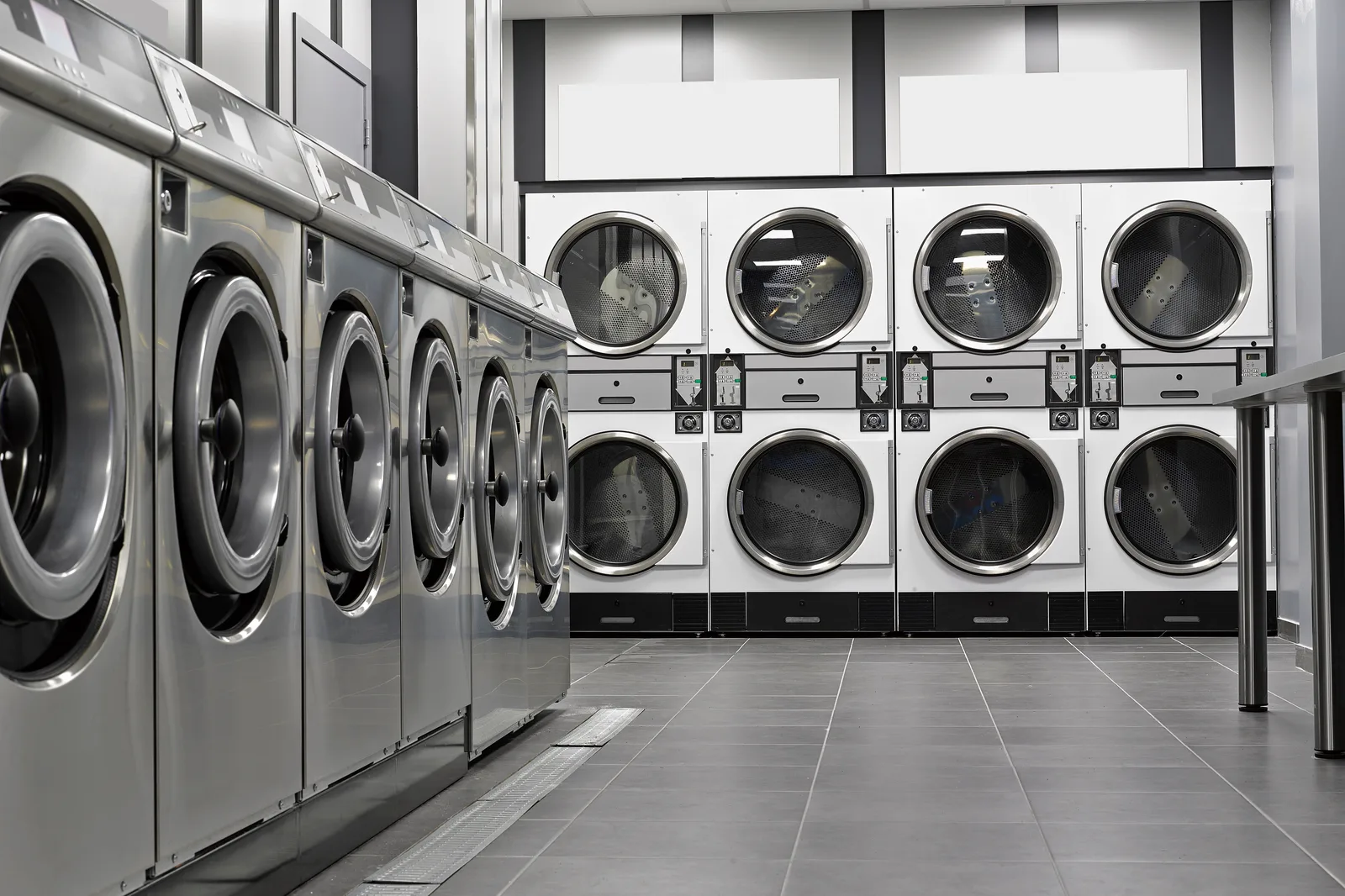

Business income coverage replaces the net revenue a laundromat loses when a covered event forces it to close or run at reduced capacity during repairs. Paired with extra expense, it keeps a temporary shutdown from becoming a permanent one — funding the income you would have earned and the costs of getting reopened faster, governed by a waiting period and an indemnity period that decide when payment starts and how long it lasts.
What business income coverage replaces
When a covered loss — water damage from a burst supply line, a fire, an equipment breakdown — forces a laundromat to close, the machines stop earning, but the bills do not stop arriving. Business income coverage answers that gap. It pays the net revenue you would have earned during the restoration period, plus continuing expenses like rent and loan payments that accrue whether or not a single turn runs.
For a laundromat, downtime is uniquely costly because revenue is volume-driven and continuous. Every hour the floor is dark is lost turns that never return. That makes this coverage a close companion to your property insurance — property funds the physical rebuild, business income funds the lost earnings during it. Owners weighing the value of the line should start with what drives laundromat insurance cost, because the same revenue profile that sets your premium also sets your interruption exposure.
How extra expense differs
Business income and extra expense are usually written together, but they answer different problems. Business income replaces lost revenue. Extra expense funds the additional costs you take on to reduce the downtime — expediting a replacement machine, renting temporary equipment, paying overtime to rush a repair, or temporarily relocating a wash-dry-fold operation.
The distinction matters because extra expense can actually lower the total claim. Money spent to reopen a week sooner is money that prevents a week of lost income. A well-structured form lets the carrier and the owner make that trade deliberately: spend on extra expense where it shortens the interruption, and let business income carry the rest. This is especially relevant for a full-service laundromat where idle staff and committed commercial accounts raise the cost of every dark day.
There is also a payroll question buried in extra expense. During a closure, an owner often wants to retain trained attendants rather than lose them to other jobs, because rehiring and retraining after reopening is its own cost. Business income forms can be written to include ordinary payroll for a defined period, or to limit it — a choice worth making deliberately for a staffed operation. The continuing obligation to employees, and the worker-protection framework summarized at the U.S. Department of Labor workers’ compensation topic page, are part of what makes downtime planning different for a full-service site than for an unstaffed one.
The waiting period
Business income does not begin paying the instant the doors close. A waiting period — a short time deductible measured in hours — must pass first. Its purpose is to screen out brief, self-resolving interruptions so the coverage focuses on losses long enough to matter.
Once the waiting period elapses, coverage pays the lost income for as long as restoration reasonably takes, subject to your limit and indemnity period. A shorter waiting period costs more but starts paying sooner; a longer one trims premium while you absorb the early hours yourself. The same time-deductible logic governs the equipment breakdown coverage business-income add-on, which is why the two should be coordinated rather than chosen in isolation.
Actual loss sustained — proving the claim
Most business income is written on an actual-loss-sustained basis, abbreviated ALS. Rather than paying a flat scheduled amount, the carrier reimburses the income you genuinely lost, reconstructed from your financial records. That makes the quality of your bookkeeping a direct input to the size of your recovery.
Sales reports, tax returns, and machine-revenue data are what prove an ALS claim. A laundromat that keeps clean records — collection logs, card-system reports, monthly statements — can document exactly what the dark weeks would have produced. One that relies on rough cash estimates will struggle to substantiate the loss. Good records also help at renewal and in a sale, as our guide to selling your laundromat and its insurance history explains, because the same financial trail underwriters use to price the risk is the trail that proves a claim.
Real-World Scenario: A supply line behind a bank of front-loaders fails overnight and floods the floor, soaking the lower electrical and shorting several machines. The site must close for weeks while contractors dry the slab, replace wiring, and rebuild the damaged machine bank. Property coverage funds the physical repairs. Business income reconstructs the lost turns from a year of machine-revenue reports and pays the owner’s continuing rent and loan payments throughout the closure, and extra expense covers the rush fees to expedite replacement machines so the doors reopen sooner.
The extended period of indemnity
Reopening is not the same as recovery. A laundromat that sat dark for weeks does not regain its full traffic the day the lights come back on — customers who found another store take time to return. The extended period of indemnity continues business income coverage for a set time after repairs are complete, funding the ramp back to pre-loss revenue.
This is the most frequently overlooked piece of the coverage and often the most valuable. Without it, payment stops the moment the doors reopen, leaving the slowest, leanest weeks of the recovery uncovered. Selecting a realistic extended period — one that reflects how long it actually takes to rebuild a neighborhood customer base — is a judgment call we make with each owner based on the market and the operating model, the same factors covered in insurance cost by operating model.
Why restoration timelines run long
The indemnity period only protects you if it is long enough for a realistic worst case, and laundromat restorations are slower than owners expect. Water-damaged electrical systems must be dried, tested, and often replaced before power is restored to a wet machine bank. Permits and inspections add time. Specialty equipment can carry long lead times. And the rebuild must meet current code, which can mean upgrades beyond a simple like-for-like repair — the fire and life-safety provisions maintained through the NFPA codes and standards frequently drive those requirements, and workplace-safety rules under OSHA 29 CFR 1910 shape how the work area is managed during reconstruction. An indemnity period set to a hopeful timeline rather than a realistic one is the most common reason a business-income claim runs out of coverage before the store is whole.
Common gaps that leave a claim short
Business income claims fail or fall short in a few predictable ways, and each is avoidable. The first is an indemnity period set too short, as described above — the coverage simply runs out before the store is whole. The second is a limit based on stale revenue figures; a laundromat that has grown since the policy was written can be underinsured against its current earnings, so the limit should be revisited as the business changes. The third is a coverage mismatch on the triggering loss: business income only pays if the underlying cause is covered, so a downtime loss from an uninsured peril produces no recovery no matter how well the income limit is set.
The fourth gap is documentation. An actual-loss-sustained claim is only as strong as the records behind it, which is why the bookkeeping discipline discussed above is not optional. The fifth, specific to staffed sites, is payroll treatment — deciding in advance whether to insure ordinary payroll during a closure so the decision is not made under pressure mid-claim. Walking through each of these before a loss is part of how we structure the line, and it connects to the broader renewal picture, since a well-documented operation also fares better when a prior claim hits the file, as our slip-and-fall renewal guide describes.
Coordinating with the rest of the program
Business income only responds when the underlying loss is covered, so it must be coordinated across the program: property for named perils, the equipment breakdown add-on for mechanical and electrical failures, and general liability standing apart for third-party claims. A gap in any one can leave a downtime loss uncovered even when business income is in place. Climate-driven loss frequency varies widely, which is why we track cost by state climate, and a prior interruption claim can shape your terms much like the slip-and-fall renewal impact does.
Business interruption forms and their indemnity provisions are regulated at the state level; your state insurance department, listed in the NAIC directory of state insurance departments, is the authoritative source for what applies where you operate, and federal fire and life-safety references maintained through the NFPA codes and standards inform the rebuild standards that drive restoration timelines. High-rent markets raise the stakes — owners in New York, California, Illinois, and Florida carry continuing expenses that make a longer indemnity period worth weighing. To size business income to your actual revenue, start a quote or read more about us.